

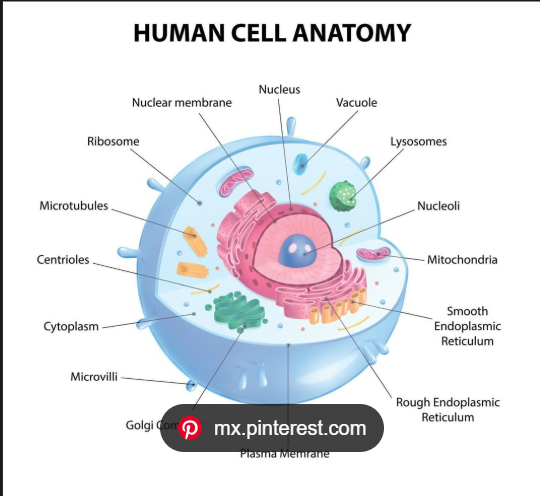
Cells: the basic unit of life
A cell is the smallest structural and functional unit of a living organism. Unicellular organisms carry out all essential activities within one cell; multicellular organisms distribute work among specialised cells. Cell theory states that living organisms are composed of cells and that new cells arise from existing cells.
All cells have a plasma membrane, cytoplasm, genetic material and ribosomes. The key distinction is how the genetic material and internal reactions are organised. A prokaryote has a nucleoid without a nuclear envelope; a eukaryote has a membrane-bound nucleus and extensive internal compartments.
| Feature | Prokaryotic cell | Eukaryotic cell |
|---|---|---|
| Genetic material | Usually a circular chromosome in a nucleoid | Linear chromosomes within a nucleus |
| Membrane-bound organelles | Absent | Present |
| Cytoplasmic ribosomes | 70S | 80S |
| Examples | Bacteria and archaea | Plants, animals, fungi and protists |
- Plant and animal cells are both eukaryotic. A cell wall does not make a cell prokaryotic.
- Mitochondria and chloroplasts possess their own DNA and ribosomes. Mature mammalian red blood cells are specialised exceptions that lack a nucleus.
The plasma membrane and transport
The fluid mosaic model describes a dynamic phospholipid bilayer containing proteins. Hydrophilic heads face the watery surroundings, while hydrophobic tails face inward. The membrane controls exchange, receives signals and helps cells recognise one another.
Simple diffusion moves molecules down a concentration gradient without a carrier. Facilitated diffusion also moves substances down their gradient, but uses channels or carriers. Active transport moves substances against an electrochemical gradient and requires an energy source. Osmosis is the movement of water through a selectively permeable membrane from higher to lower water potential.
- An animal cell may swell in a hypotonic solution and shrink in a hypertonic solution.
- A plant cell becomes turgid when water enters; the wall resists excessive expansion. In a sufficiently hypertonic solution, the protoplast pulls away from the wall during plasmolysis.
- Endocytosis brings material into cells using vesicles. Exocytosis releases vesicle contents outside the cell.
Organelles and the division of work
Organelles allow different reactions to occur under suitable conditions. Follow the movement of a secreted protein to connect several structures: a ribosome synthesises it at the rough endoplasmic reticulum, transport vesicles carry it to the Golgi apparatus, and a secretory vesicle delivers it to the plasma membrane.
| Structure | Main role |
|---|---|
| Nucleus and nucleolus | Store genetic information; the nucleolus assembles ribosomal subunits |
| Rough ER | Synthesis and early processing of many secreted and membrane proteins |
| Smooth ER | Lipid synthesis, detoxification and calcium storage in specialised cells |
| Golgi apparatus | Modification, sorting and packaging |
| Lysosomes | Intracellular digestion with hydrolytic enzymes |
| Mitochondria | Aerobic respiration and much cellular ATP production |
| Chloroplasts | Photosynthesis in plants and algae |
| Central vacuole | Storage, digestion and maintenance of turgor in plant cells |
- Ribosomes are not membrane-bound organelles.
- Plant cells also contain mitochondria and perform cellular respiration.
- The cytoskeleton supports cell shape, intracellular transport and movement.
Biomolecules and enzyme action
Carbohydrates provide fuel and structural material. Proteins act as enzymes, transporters, receptors and structural components. Lipids contribute to membranes and long-term energy storage. Nucleic acids store and transmit biological information. A nucleotide contains a nitrogenous base, a pentose sugar and phosphate.
Enzymes accelerate reactions by lowering activation energy. They do not change the equilibrium of a reaction and are not consumed by normal catalysis. Substrate binding depends on the shape and chemical properties of the active site. Temperature, pH and substrate concentration influence reaction rate.
- At low substrate concentration, adding substrate can increase reaction rate. Once the available active sites are occupied, the rate approaches a maximum.
- A competitive inhibitor competes for the active site; increasing substrate concentration can reduce its effect in the simple model.
- High temperature or extreme pH can disturb enzyme structure. Do not confuse an enzyme optimum with the condition that gives the most collisions.
The cell cycle and mitosis
Interphase includes G₁, S and G₂. Cells grow and carry out normal functions in G₁, replicate DNA in S phase and prepare further for division in G₂. Some cells leave the active cycle and enter a non-dividing G₀ state. Interphase is metabolically active, rather than a period of inactivity.
Mitosis separates replicated chromosomes into daughter nuclei. Chromosomes condense in prophase, align at the equator in metaphase, and sister chromatids separate in anaphase. Nuclear organisation is restored in telophase. Cytokinesis divides the cytoplasm, using a cleavage furrow in animal cells and a cell plate in most plant cells.
Worked example: count chromosomes and DNA separately
A diploid cell has 12 chromosomes in G₁. After S phase, G₂ contains 12 chromosomes and 24 DNA molecules because every chromosome has two sister chromatids. When sister chromatids separate in mitotic anaphase, each becomes a chromosome: the still-undivided cell briefly contains 24 chromosomes, with 12 moving toward each pole.
Meiosis and genetic variation
Meiosis has one DNA replication followed by two divisions. Homologous chromosomes pair during prophase I. Crossing over exchanges DNA between non-sister chromatids in pachytene; chiasmata become visible later in diplotene. Homologous chromosomes separate in anaphase I, reducing the chromosome-set number. Sister chromatids separate during meiosis II.
Independent assortment of homologous pairs and crossing over generate new allele combinations. In a diploid organism, meiosis typically produces haploid products. Fertilisation restores diploidy. Mitosis usually maintains chromosome-set number, whereas meiosis reduces it.
- Homologous chromosomes carry corresponding gene loci; sister chromatids are the replicated copies of one chromosome.
- DNA does not replicate again between meiosis I and meiosis II.
- For a 2n = 12 cell, each product after meiosis I has 6 chromosomes with two chromatids each; after meiosis II, each has 6 single-chromatid chromosomes.
Keep these ideas close.
- Membranes regulate exchange; organelles compartmentalise cellular work.
- DNA amount doubles in S phase while chromosome number stays the same.
- Mitosis separates sister chromatids; meiosis I separates homologous chromosomes.
- Always specify whether a count refers to the whole cell, one pole or one daughter cell.
Cell Biology MCQs
Choose an answer, check your understanding and learn the reasoning.
During which phase of the cell cycle does DNA replication occur?
Which structure is present in both prokaryotic and eukaryotic cells?
A diploid cell has 12 chromosomes in G₁. How many chromosomes and DNA molecules are present in G₂?
Which organelle modifies, sorts and packages proteins received from the endoplasmic reticulum?
Crossing over between non-sister chromatids occurs during which stage of meiosis I?
What directly causes sister chromatids to move toward opposite poles during mitotic anaphase?
Continue your reading
Use the official NCERT textbook library and your current syllabus alongside practice.
Explore more biology chapters →